
Recently, the Ministry of Education of China announced the results of the review for Sino-foreign cooperative education projects applied for in the first half of 2026. The undergraduate program in Electronic Information Engineering jointly offered by Qingdao University of Technology (QUT) and Buryat State University (Russia), and the undergraduate program in Software Engineering jointly offered by QUT and the University of Pannonia (Hungary), have both officially passed the qualification assessment. The approval information has been published on the Chinese-Foreign Cooperation in Running Schools Information Platform. With these additions, the university now operates six undergraduate-level and one master’s-level Sino-foreign cooperative education programs, marking a new breakthrough in QUT's internationalization efforts.
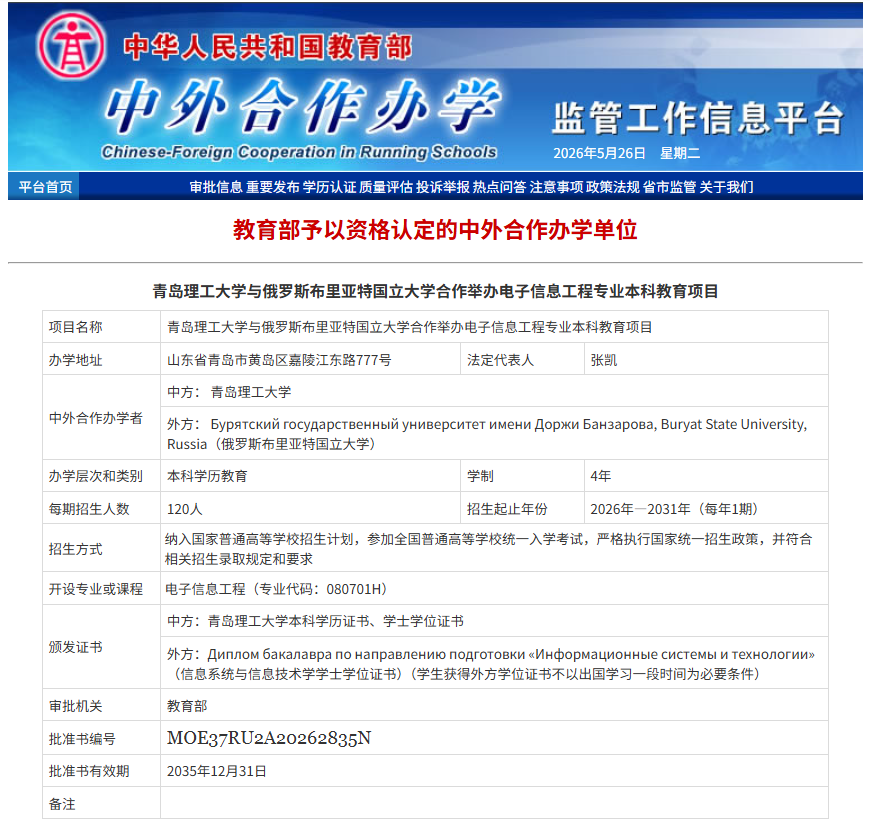
The undergraduate program in Electronic Information Engineering, in cooperation with Buryat State University, is scheduled to begin enrollment in 2026, with an annual intake of 120 students. The program has a four-year duration and adopts a “4+0” dual-degree model, meaning all four years of study will take place at QUT in Qingdao. Upon completing the required courses and meeting the graduation requirements of both institutions, students will receive QUT’s graduation certificate and bachelor’s degree certificate, as well as a Bachelor’s degree in Information Systems and Information Technology from Buryat State University.
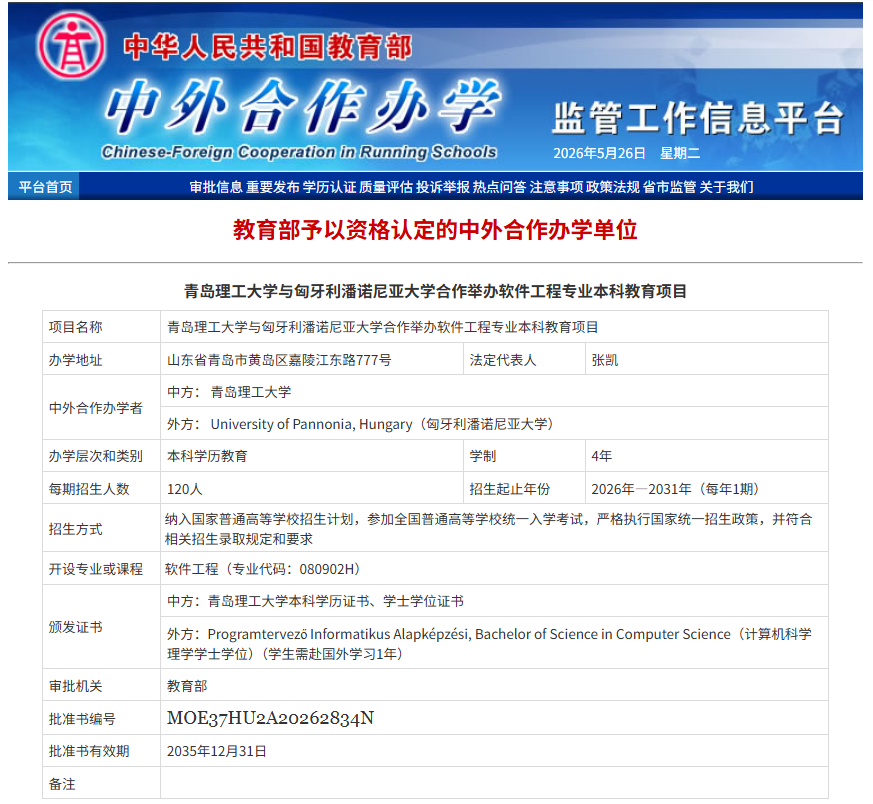
The undergraduate program in Software Engineering, in cooperation with the University of Pannonia, is also scheduled to begin enrollment in 2026, with an annual intake of 120 students. The program has a four-year duration and adopts a “3+1” dual-degree model, taught jointly by Chinese and Hungarian faculty in English. In the fourth year, students will go to the University of Pannonia in Hungary to study. Upon completing the required courses and meeting the graduation requirements of both institutions, students will receive QUT’s graduation certificate and bachelor’s degree certificate, as well as a Bachelor of Science in Computer Science from the University of Pannonia.
The application process for both programs was initiated in the second half of 2025. To ensure high standards in launching the new programs, the university adhered to the principle of unified leadership of the Party Committee and high-level strategic planning. The university coordinated efforts from multiple offices and departments, including the Administration Office, the Organization Department of the Party Committee, the Publicity Department of the Party Committee, the Academic Affairs Office, the Human Resources Office, the Student Affairs Office, the Finance Office, the Assets and Laboratory Management Office, the Office of International Affairs, the College of International Education, and relevant teaching faculties. A dedicated task force was formed to work collaboratively and ensure the quality of the project applications.
The successful approval of these two programs effectively integrates overseas high-quality educational resources with the university’s disciplinary strengths, filling gaps in internationally-oriented talent cultivation in fields related to Russia and Hungary. In the future, the university will further innovate its international education mechanisms, continue to expand in-depth cooperation with high-level overseas universities in talent cultivation, research collaboration, and faculty exchanges, and enhance the quality of its international education programs, thereby cultivating more globally competitive application-oriented talents to serve national strategies and regional development.
(Reporters: Wei Yanan, Feng Zhiguo; Reviewers: Zhang Peng, Jia Yueyue)
Appendix: Brief Introductions of Partner Universities
Buryat State University was founded in 1932 and is a public research comprehensive university in Russia. The university covers disciplines such as humanities and social sciences, natural sciences, engineering, medicine, and education, establishing a complete talent cultivation system from undergraduate to doctoral levels. In the EduRank evaluation system, the university is ranked approximately 120th among Russian universities and first in the Siberian region, demonstrating strong comprehensive strength. The university has been selected for the Russian Ministry of Science and Higher Education's “Priority 2030” program (one of 106 universities nationwide), focusing on cross-disciplinary integration in areas such as information technology and system modeling, engineering economic optimization, biomedicine and medical biotechnology, and ecological environment protection, creating a number of advantageous disciplines that meet regional development needs and combine applied value with research depth.
University of Pannonia is a national comprehensive research university ranked in the top five in Hungary. It covers a complete system of disciplines including arts, sciences, engineering, economics, agriculture, arts, and social sciences, featuring a development model of “benchmarking applied disciplines and solidly establishing basic disciplines.” The Faculty of Information Engineering at the University of Pannonia has been awarded the title of “Excellent Research Institution” by the Hungarian Academy of Sciences (MTA). Computer science is a key discipline of the university, and through solid academic accumulation, cutting-edge research layout, and deep industry-academia integration, the university has demonstrated strong competitiveness and recognition in Central and Eastern Europe and beyond. According to EduRank 2025 data, its computer science field ranks 5th in Hungary, placing it in the top 5% globally. The faculty has published a total of 2,885 academic papers, which have received 45,349 citations, reflecting continuously rising academic influence.